
The Amalfi Coast

Amazing excursions on the Amalfi Coast, Sorrento, Pompeii
What towns should you visit on the Amalfi Coast? Positano, Ravello, Scala, Maiori, Archaeological sites of Pompeii, Herculaneum or Paestum, the Islands of Capri and Ischia
The best place to stay enjoying excursions on the Amalfi Coast? Amalfi Coast bed and breakfast Antico Borgo dei Limoni to explore the amazing locations of this territory! Excursions on the Amalfi Coast will allow you to know about the extraordinary artistic, cultural and gastronomic heritage of this territory:
- Amalfi, Atrani, Scala, Ravello, Minori, Maiori, Vietr sul Mare, Salerno
- Emerald Grotto in Conca dei Marini, Fjord of Furore
- Positano, Sorrento
- The islands of Capri and Ischia
- Roman archaeological excavations of Pompeii and Herculaneum, buried by the furious eruption of Vesuvius in 79 AD
- Greek Tmples in Paestum
At the reception of Antico Borgo dei Limoni b&b in Amalfi, you will find all the useful information to reach it by bus, rental car or by sea, and about the most beautiful excursions on the Amalfi Coast and its surroundings.
The Amalfi Coast
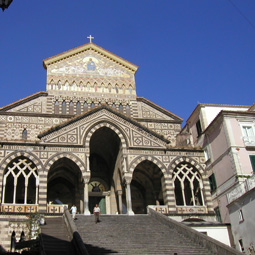
The Amalfi Cathedral is dedicated to Saint Andrew and it is located at the end of a steep staircase from where overlooks the homonymous square at the center of which stands the eighteenth-century fountain of St. Andrew of the People. The building, whose original structure dates back to the ninth century, was rebuilt in the 1203 in Arab-Norman forms of Sicily and then over the centuries altered several times. The façade, particularly beautiful, rebuilt after the collapse of 1861, has fine mosaics: in the eardrum is depicted Christ enthroned between the symbols of the Evangelists and the terrestrial Podesta, designed by Domenico Morelli. To the left of the façade stands the bell tower, begun in the 1180 and completed in the 1276, which, although more than once restored, retains its original appearance.
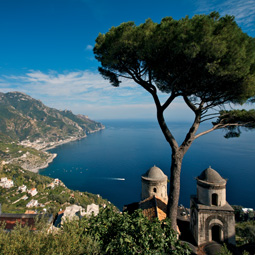
The dome it's a Basilica of Benedictine- Cassinese derivation, built in the late eleventh century on the central
plaza of the Bishopric. The building with three naves has a facade with three ancient marble portals. On the door they
are represented in a symbolic way the animal and plant world, the universe and human hierarchies of the Church. The right
aisle has a fourteenth-century sarcophagus and a precious panel of the fifteenth-century depicting the Archangel Michael
defeating Satan. Down the aisle, next to the presbytery, there is the chapel of San Pantaleone, with inside the ampoule of
glass, gold and silver containing solidified blood of the saint, who miraculously liquefies each year. At left of the
central nave is the ambo of Epistle, dating from the twelfth century, decorated with two mosaics.
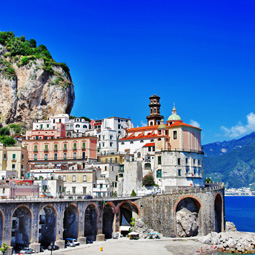
The church of San Salvatore de Birecto.
Here it took place the coronation of the highest government authorities to which was solemnly placed on the
head the cap ("Birecto") as doge. The Bell tower of the Church of San Salvatore was remodeled in neoclassical style but
the church is more ancient, founded in 940, it contains a pluteus marble of the late eleventh century showing high reliefs
in the Byzantine style and anthropomorphic figures.
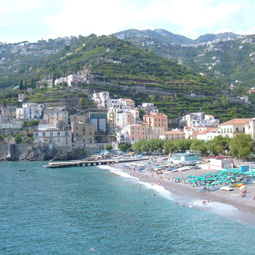
Minori had the original name of "Reginna" and was part of "Reginna Maior", today Maiori, then "Reginna Minor" from the neighboring country
to which he belonged. Some historians believe that Minori and Maiori were founded by the Etruscans, for the epithelium
final "inna", common to many Etruscan words. Certain there is the massive presence of the ancient Roman
villas and residences, still admired.
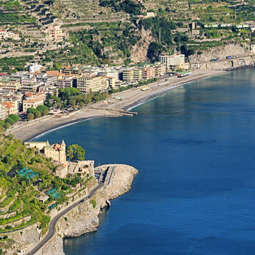
According to history, the city of Maiori was founded by the Etruscans, as evidenced by its original name
of "Reghinna Maior" and its etymological root "inna". Maiori, a colony of Amalfi and home of the Arsenals, became very soon
a thriving merchant marine and it was able to build ships of great capacity.
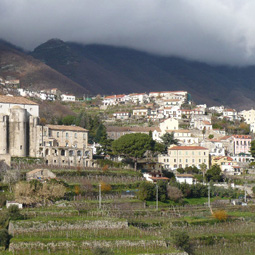
Located on a hill at about 400 meters above sea level, Scala is the oldest town on the coast. According to an ancient chronicle it was founded in the fourth century by shipwrecked Romans headed to Constantinople. The news is not historically proven. Certain is that Scala and Ravello, in the Middle Ages, were the main bastions of the fortified area of Amalfi.
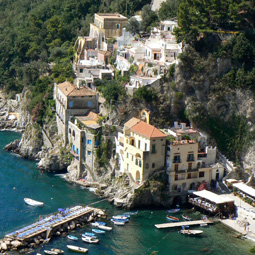
The Emerald Grotto.
You enter in the cave with a lift and some stair steps. The visit takes place on board of a small rowing boat that goes
around the cave. The fascinating colors of the sea inside the cave (the maximum depth reaches 22 meters) range from cobalt
blue, cyan, turquoise and emerald green.
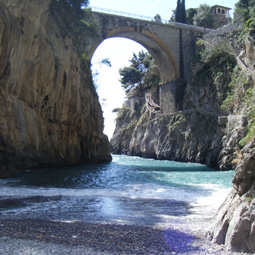
It is a small village that is spread overlooking the sea. The fjord that welcomes it looks like a real natural spectacle which is reflected in the sea of Amalfi: the state road crosses it through a bridge about 30 meters high.